The role of websites is changing. And currently, your website serves as your business’s singular source of truth. As such, it shoulders the tremendous responsibility of acting as your business’s digital information directory, tasked with building AI trust and driving discovery.
Your website’s big job, it turns out, is more essential than ever!
Generative engine optimization, or GEO, is now the Holy Grail that determines and grants visibility for your business, services, or products via AI discernment. Like the formidable Google search power before it, whether or not you get that visibility in the new digital marketplace is at the pleasure and discretion of the powerful beasts of AI.
As always, businesses and marketers anxiously work to crack the code for AI notice so they can remain seen, stay relevant, and grow online.
Statistics tell a story, however, proving the impact AI is having on search and how people are searching. More significantly, generative search increases the chance of “Zero-Click” results, affecting business website traffic and visitor data.
For example, searches ending without a click jumped from 58% to 68% over just two quarters (2025 to 2026), according to research. And with data like this, it’s no wonder people are asking, “Has AI finally killed off SEO?”
What we need to remember throughout the transition is that, like Google search, AI search optimization also means relying on an elusive and moving target. And right now, the evolution of search overall is evolving faster than at any time in history.
Changing Role of Websites in an AI and ‘Zero-Click’ World
Part of the evolution of your website from ‘digital home’ to ‘data center’ means you must think of it as a source for platforms and AI Agents and not simply as a destination for visitors. This reinforces the importance and need to provide trustworthy, structured, AI-readable information.
What we know is that SEO (search engine optimization) is changing, not disappearing. Getting found online still matters to businesses and to customers looking for them. And while there are consequences to historical SEO because of the takeover of AI, maintaining trust, authority, and credibility remains critical.
Viable information retrieval is now of top-level importance to how you structure your site and its contents.
And while I still believe human-focused/people-first writing and content ultimately wins in most scenarios, it’s crucial to pay close attention to the swiftly changing tides of digital business and marketing at this crossroads.
Snippet inclusion and showing up in SERPs (search engine results pages) depend in large part on the structure of your website. Keyword hacking and chasing empty clicks or views no longer work.
But the good news is that many of the optimization rules we know and love are still true.
Things like:
- answering the questions your business gets asked most,
- providing relevant definitions and helpful product/service details,
- giving comparison results, and
- proving your differentiation and why it matters,
for a few good examples.
Original research, quotes, case studies, UGC (user-generated content), and, of course, unique thought leadership pieces, along with a good dose of business storytelling, are also highly effective in making your content sticky.
Shifting Website Metrics and How to Measure Success
No longer focusing on clicks and views, new metrics focus on branded recall, page leads, and visibility in multiple AI and discovery engines. With AI Agents scanning content, site clicks represent higher-intent visitors. This challenges you to maintain a higher standard for each post and page on your website and to deliver higher impact for your business.
In addition to creating concise answer snippets, it’s a good idea to create deeper “skyscraper” content that adds depth to your valuable content resources, ensuring they stand out from generic and repetitive pieces.
Heck, it’s probably a good time to review and revive all of your site’s key pages. Recheck copy in particular, so AI crawlers can easily understand exactly (and concisely) what’s going on while delighting guests with clear communication.
Don’t forget the structural points you tend to let slip over time. Think about long-tail keywords and creating service-specific pages; use specificity, Q&As, FAQs, definitional paragraphs, bullet lists, and tables for AI retrievability.
Clean backend structure: headers, schema, featured images, etc., and while you’re at it, decide if your category topics match your business and brand messaging. Also, best practice currently dictates that you have as few categories as possible; again, to clearly reinforce your business focus and expertise.
Owning your web presence and turning it into business happens when you publish authentic expertise, organize it for machine discovery, and focus on clarity.
Website Optimizations: Home, Core Pages, and Much More
Beyond technical and structural optimizations, success relies on how effectively you weave core brand messaging into your copy, content, and media. It starts with your website, where these elements come together to build consistent, easily recognizable assets for your business. But once again, there’s beauty in the details.
First, consider how the NEW Customer Journey reduces the opportunity and timeframe for nurturing visitors. This means each page and post needs to hit harder! Does each post or page smoothly deliver a next-step action, for example? Is every button on your site working properly, and is the copy on it tested or up to current best practices? Do you have current CTR data to determine if they can be improved? Any broken links?
See, I told you: the details, the details. The minute details matter.
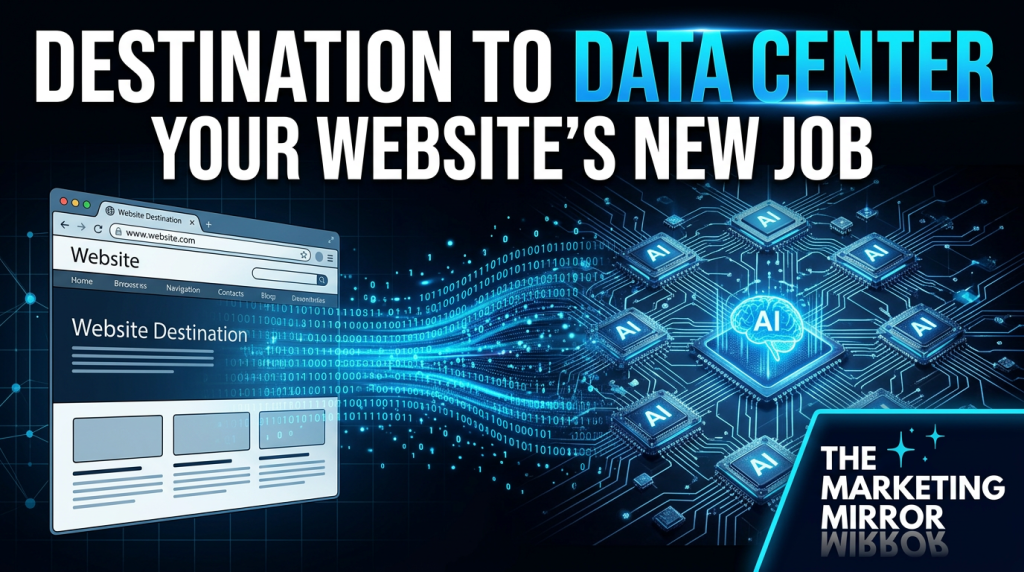
Your Homepage is Your Welcome Center
Your Homepage may be the most important page on your website, especially as your AI attraction magnet. Make sure it passes the “grunt test,” as Donald Miller calls it, meaning visitors to your website don’t have to think at all to understand what you do, who you serve, what makes you different, and what the next steps are.
Unlike what your Landing Page design typically calls for—one and only one destination CTA—your homepage offers several CTAs to invite people to a next step—one that fits them best.
Homepages are foundational—they’re the digital anchor to your business. But they also act as a concierge, graciously directing people to the next appropriate stepping stone, again, specifically for them. Thus, your page’s job is to help generate further interest and build a connection, while purposefully guiding the way.
Now, if you’re smart, you’ll see each possible path as a journey or experience you want to give someone. Why not make it inviting, warm, and friendly, but also, as a priority, loaded with value that fits their needs?
Cultivating Your Core Pages
Carefully select your key categories to distinguish the pathways you’ll want to create. But also, these key categories should have a Cornerstone Content Page(s) for building purposeful content hubs around your key category topics. Now is the time to tighten these up and to consider AI Agents and GEO in how you structure and word particular parts of your pages and core category content.
Review the metadata, making sure you provide what search engines need to scan/read to increase your visibility and reach. Satisfy user intent by using the correct keywords, including long-tail and related keywords, to clarify purpose and meaning and attract the right visitors. Use jargon and lingo that resonates with your audience and confirms to them that they’re in the right place.
Optimize your ‘Menu Tabs’ with words and phrases to clearly convey the specifics. For example, use “Social Marketing Management to Drive Organic Brand Growth,” or “Email Marketing Strategy/Packages for Unique Newsletters Worth Getting,” instead of “Services.” (Hey, should I use these on my site?!)
Update your website, especially your blog, as often as possible, making sure to check and recheck links for anything that’s broken or outdated. Fix broken links, and as needed, combine blog posts that are repetitive or compete for keywords.
Like the Homepage, Services and Products Pages, the next most highly viewed pages also require the same higher-level scrutiny and ongoing checkups. Consider using FAQ pages or sections, a table of contents, and even grids or graphics to capture AI attention.
Think of the snippets section in search and keep things as straightforward, clear, and focused as possible. Keep a close eye on Contact Pages and Booking Buttons or Links to be certain they are always working and connected.
Destination: Website for AI and Search Recognition
For core pages and throughout your website, maintain clear positioning, understandable product/service details, and a next-step directive for visitors. Leaning into your website’s new role as a data center means you need to pay attention to the fine points and details. But sculpting a singular source of truth for your business is crucial.
Structured, trustworthy, and quotable information speaks to search and people alike.
Publishing authentic content with proof, originality, and organized knowledge allows AI and search engines to trust (and recall) your brand. Brand searches also feed the algorithm, making social marketing a key factor in building reputation, expertise, and trust, baked into recognition.
Fewer website visitors demand higher efficiency and conversion rates from your site, beginning with your Homepage. Audit your site, starting with the most viewed pages. Scrutinize them until you’re screaming brand signals with clarity and focus throughout.
Website relevance comes from what you put into it to present an interesting, thriving, current, and welcoming environment. But remember, information is currency and helps build authority and trust. Trust is currency’s gold standard. It’s also a key goal for your website and digital presence.
Rolling out the red carpet for search, AI scanning, Agentic AI, and people means your website still has a key role to play in your digital destiny. It’s still the most looked-at and expected “business card” for your brand, a 24-7 available source of information for your company, and a bridge to sales.
I’d love to know: what’s your take? Thanks so much.
More From the Blog…
- Unraveling Diverse Opinions on AI for You
- The Changing Role of Websites: Destination to Data Center
- Has AI Finally Killed Off SEO?

- How to Build a Recognizable Brand

- The Power of Composition in Visual Storytelling

- Pinterest Update: A Blueprint for Top-Notch Business Results


Publishing truly helpful content is less words seems to work these days Sue-Ann. Our blogs are data centers but AI cites FAQ style posts; at least from my experience. I delete far more than I add while updating old posts. My AI citations rise by subtracting. Like the old show Dragnet…..”Just the facts, ma’am.”
Share as much practical advice as needed to sufficiently answer questions. Cut everything else out. These days at least, this is how search engine traffic works.
Ryan:
Thanks for sharing your take on this one. I love writing and wordplay, so editing is an ongoing practice for sure. Getting the answers answered is critical, as is paying attention to metadata, too. I don’t know, but I think it’s all a big experiment in some ways when you’re a blogger! Best, Sue-Ann