If you’re wondering if SEO is finally dead and done-for, guest author Corey Hinde is here to settle the question once and for all!

A plain-English look at what’s happening to search—and what it means for your business
If you’ve Googled anything lately, you’ll have noticed something different.
Above the usual list of blue links, there’s often a large AI-written summary that answers your question immediately. No clicking required. No scrolling through ten websites to find what you need.
If you’re a business owner who has spent years—and probably some serious money—trying to rank on Google, this can be a scary sight.
It looks like the thing you invested in is quietly being switched off in front of you.
So, the question many business owners are asking is simple:
Has AI finally killed off SEO? Is SEO Dead?
The short answer is no.
But the honest answer is that the old version of SEO—the one built almost entirely around technical fixes, backlinks, and churning out blog posts—is fading.
What’s replacing it isn’t a gimmick or simply a rebrand. It’s a genuine shift in how people find businesses, and it requires a different mindset.
Instead of thinking only about “SEO,” it helps to focus on the goal SEO was always meant to achieve: getting found online.
Let’s look at what’s changed, what the evidence says, and what still works.
Search traffic is genuinely dropping
This isn’t just a feeling. It’s measurable, and several large studies have now confirmed it.
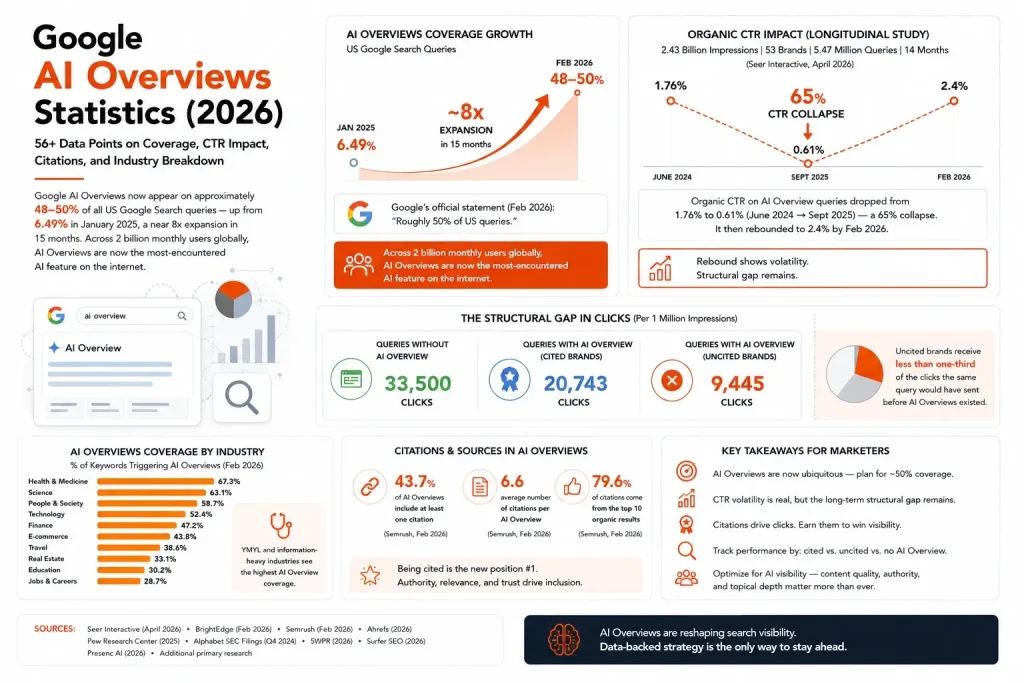
Research from Seer Interactive tracked 2.43 billion search impressions across 53 brands and 5.47 million queries over 14 months.
It found that click-through rates on searches showing an AI Overview fell from 1.76% to 0.61% between June 2024 and September 2025—a 65% collapse. There was some recovery in early 2026, with the click-through rate reaching 2.4% by February.
A separate study went even further.
Researchers ran a controlled experiment in which some users saw Google as normal, while others had AI Overviews hidden in real time.
The result was significant: removing AI Overviews increased clicks to external websites by 38%. Zero-click searches—where the user never visits another website—rose from 54% to 72% when AI Overviews were shown.
Because this was a randomized experiment, rather than simply a comparison of before-and-after data, it provides strong evidence that AI summaries are taking clicks away from websites.
Pew Research found a similar pattern.
Users clicked a normal search result 15% of the time when no AI summary appeared. When an AI Overview was shown, that figure fell to just 8%.
This isn’t a niche problem, either.
Depending on the industry, AI Overviews now appear on a large proportion of searches. One analysis found that they appeared for 88% of healthcare queries, 83% of education queries, and 82% of B2B technology queries.
Comparison searches are particularly affected. Searches such as “X versus Y” can trigger an AI Overview more than 95% of the time.
So yes—for many businesses, the traffic numbers in Google Search Console really are heading down.
It isn’t necessarily a technical mistake or a sudden loss of rankings. It’s a structural change in the way Google displays its results.
Not clicking isn’t the same as not choosing
It would be easy to read those figures and conclude that the game is over and SEO is dead.
But there’s an important detail hidden inside the same research: being a source that AI trusts is now more valuable than it used to be.
Seer Interactive’s research found that brands cited inside a Google AI Overview earned more organic and paid clicks than businesses that weren’t cited—even when they appeared for the same search.
Another analysis of the figures found that a cited business received 20,743 clicks per million impressions, compared with 9,445 clicks for a business that wasn’t cited.
In other words, the pie has become smaller, but the size of your slice depends heavily on whether the AI trusts your business enough to mention or cite it.
Visibility hasn’t disappeared. It has become concentrated into a smaller, more competitive space.
That’s the part the “AI has killed SEO” headlines often miss.
People haven’t stopped finding businesses through search. The mechanism for being found has changed, and many businesses haven’t yet caught up with what the new system rewards. For example, if you are a local Solar Energy supplier, you might use Google Ads, your Google Business Profile, and hope to get found in some AI summaries and maybe a YouTube video as well, all on page 1 of Google.
The old foundations are shifting
For the past 20 years, most SEO agencies have focused on three main things:
- Technical fixes, such as website speed, mobile usability, and clean code
- Backlinks from other websites
- Regularly publishing blog posts to target keywords
That formula isn’t dead, but it’s no longer the whole story.
Backlinks, for example, don’t carry the same weight they once did.
One analysis of current SEO ranking factors estimated that backlinks now account for around 13% of Google’s ranking weight, down from more than 50% historically.
Google’s Gary Illyes has also said that Google now needs “very few links to rank pages” and that links have become less important over the years.
Backlinks still matter, particularly when they come from trusted and relevant sources. But chasing large numbers of low-quality links is no longer a sensible strategy.
This is especially true for local businesses.
A backlink from a random overseas technology blog isn’t likely to help a local plumber, electrician, car dealer, or landscaper very much. A link or mention from a respected local organization, industry publication, or genuine business partner is far more useful.
Publishing content simply for the sake of publishing doesn’t work particularly well, either.
A smaller collection of useful, well-structured pages that directly address what customers are searching for will generally perform better than 50 thin blog posts.
The businesses that are still winning aren’t necessarily publishing more. They’re publishing smarter.
Reviews, profiles and listings matter more
While the influence of links has declined, the importance of trust signals has increased.
These signals include:
- Customer reviews
- Google Business Profiles
- Accurate directory listings
- Consistent business information
- Mentions on trusted third-party websites
According to the 2026 Local Search Ranking Factors research, reviews grew from 16% to 20% of the factors influencing Google’s local map results between 2023 and 2026.
At the same time, link signals continued to decline.
A complete and accurate Google Business Profile is also one of the most important foundations for appearing in local results.
For local businesses, this means the strongest approach now usually includes:
- A fast, accessible and helpful website
- A complete Google Business Profile
- Regular, genuine customer reviews
- Accurate listings on relevant directories
- Clear and useful content
- Consistent business information across the web
The goal isn’t to produce the largest possible amount of content or collect hundreds of random backlinks. Instead, the goal is to give Google, AI tools, and potential customers clear evidence that your business is real, trusted, active, and relevant.
Meet GEO and AEO and find out if SEO is dead or not
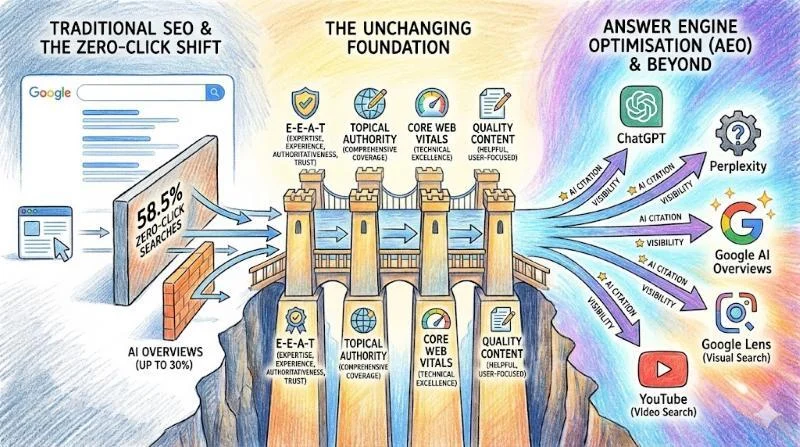
There are now new names for optimizing content for AI-generated answers:
- Generative Engine Optimization—or GEO
- Answer Engine Optimization—or AEO
Despite the new terminology, these disciplines aren’t entirely separate from SEO.
They are better understood as extensions of SEO, adapted to a different type of search result.
Traditional SEO aims to get an entire page ranked within a list of links.
GEO aims to have a useful section of that page extracted, mentioned, or cited in an AI-generated answer.
AI tools break content into smaller sections and look for the passage that most closely matches the question.
That means clarity, structure, and self-contained answers matter more than repeatedly using a keyword.
In practical terms, businesses should:
- Answer important questions directly, preferably near the top of the page
- Use clear headings and genuine question-and-answer sections
- Include specific examples, figures, processes and evidence
- Avoid vague marketing claims and unnecessary filler
- Make each important answer understandable on its own
- Maintain consistent profiles across directories and review platforms
Different AI tools also rely on different sources.
In one real-world GEO test, ChatGPT often favoured well-structured editorial roundups while Perplexity relied more heavily on directories such as Clutch and Yelp, as well as Reddit discussions and review websites.
That means there isn’t one single “AI search engine” to optimize for.
A business needs useful content on its own website and a genuine, consistent presence on the third-party platforms that AI tools use to confirm information.
If that sounds familiar, it should.
It’s very similar to the directory and citation work that has supported local SEO for years. The difference is that those listings now help influence AI-generated recommendations as well as Google’s traditional search and map results.
So, has AI killed off SEO?
No—but it has killed off the idea that SEO is a fixed checklist you complete once.
What’s fading is the version of SEO that treated rankings as the finish line:
- Complete a technical audit
- Build some backlinks
- Publish one blog post a week
- Wait for the traffic to arrive
What has replaced it is broader—and more closely connected to what businesses actually want.
The goal is now to be the answer, whether that answer appears as:
- A traditional blue link
- An AI Overview citation
- A ChatGPT recommendation
- A Perplexity source
- A business in Google’s local map results
- A listing on a trusted review or industry website
That’s what “getting found online” has always meant.
For a long time, SEO was the main route. Now there are several routes, and they overlap more than they compete. So, is SEO dead or just evolving and adjusting to AI search functionality?
A practical checklist for business owners
If you’re wondering where to put your time and money, start here.
1. Get the basics right
Your website should be fast, mobile-friendly, easy to navigate, and simple for Google to access.
These things are now basic requirements—not a complete strategy on their own.
You still also need good business content for your website too – consider getting your website professionally written to align with “what you do” and what Google, etc. want.
2. Treat your Google Business Profile like a shopfront
Don’t treat your Google Business Profile as a form you filled in once and forgot about.
Keep your services, categories, hours, phone number, website and business information accurate. Add new photos and updates regularly.
3. Build and manage customer reviews
Review recency matters as well as total volume.
A steady flow of genuine recent reviews is more valuable than a large collection of reviews gathered several years ago. BrightLocal’s 2026 consumer research confirms that customers increasingly expect both strong ratings and fresh reviews.
4. Audit your business listings
Check where your business appears across relevant directories and review websites.
Correct inaccurate names, addresses, phone numbers, opening hours and website links. Fill important gaps where competitors are listed, but you aren’t. SEO professionals can help you with this work.
This citation work supports traditional local rankings and helps AI tools confirm that your business information is reliable.
5. Write less—but write better
Create clear and useful pages that directly answer real customer questions.
A handful of strong pages will usually be more valuable than a large pile of generic posts written simply to target keywords.
6. Check how your business appears in AI tools
Search your important services and locations in ChatGPT, Perplexity and Google’s AI results.
Is your business mentioned?
If competitors appear and you don’t, look at the sources the AI tools are using. Those websites, directories, articles and review platforms reveal the visibility gaps you need to close.
Think of a used car business, for example – reviews and what other people say are vital!
7. Keep backlinks in the mix—but stop chasing volume
Backlinks still have value, but relevance and trust matter far more than quantity.
A small number of genuine mentions from respected websites in your area or industry will do more for your business than hundreds of low-quality links.
The bottom line
AI hasn’t killed SEO. It has forced it to grow up.
The tactics that treated search as a technical puzzle—a bit of code here, a pile of links there and a weekly blog post whether anyone needed it or not—are losing their grip.
What’s replacing them rewards businesses that are:
- Well reviewed
- Clearly represented across the web
- Mentioned by trusted third parties
- Consistent with their business information
- Genuinely helpful in their content
- Clear about what they do and where they do it
That isn’t really a new goal.
It’s the same goal businesses have always had: getting found online.
The only difference is that the path now runs through more places than it used to.
Latest on the blog…
- Has AI Finally Killed Off SEO?
- How to Build a Recognizable Brand

- The Power of Composition in Visual Storytelling

- Pinterest Update: A Blueprint for Top-Notch Business Results

- Going LIVE to Share and Thrive
- Human/AI Collaboration: Creativity Unleashed




This is a fascinating question, especially as AI continues to change how people search for and consume information online. I don’t think AI has necessarily killed SEO, but it is certainly forcing SEO to evolve. Traditional keyword-focused strategies alone may no longer be enough, while helpful content, genuine expertise, clear structure, and strong user experience are becoming even more important. Search behavior is changing, and content creators need to adapt to where and how audiences discover information.
I appreciate articles like this that encourage bloggers and marketers to rethink their approach rather than panic about AI. An interesting and timely discussion for anyone working in digital marketing.
Really appreciate the thoughtful takes everyone… I certainly feel like the work is on point when long time bloggers like y’all agree!
All great points, Corey.
The “clear and useful” mention is as important as ever. People want truly helpful content. Serve that up consistently to draw people to your blog through Google or any channel. Look below the AI summary on page 1 and you will see top organic results from bloggers. The link between the two always exists because AI still generates content from somewhere. That “somewhere” appears to be those top three organic results.
One point I’d add is that Google may not be the only game in town. It is the ultimate traffic source. But never look past genuine blog commenting or billions of social media users, either.
Some disillusioned Google users turned off by AI – even though AI is not going anywhere soon – migrate to Facebook, X or blogs found through social media for trusted solutions. Enter social media content. Enter genuine blog commenting.
Reading your post and dropping this comment required about 10 minutes of my time. Guaranteed someone interested in my perspective clicks though to my blog. Never mind how yourself, Sue-Ann and Lisa above bond even more strongly through our genuine give and take, amplifying our collective reach as we help each other out.
Excellent post my friend.
Ryan:
Thank you so much! Everything you mention here is on point. One thing I find myself using (and no one seems to mention) is that AI platforms provide additional sources (on some you have to request them) for every search, providing a much deeper field of results, along with a good way to confirm data or its origin, which I find so useful for research. The Comet browser, Perplexity’s AI browser, also has a discovery tab that gives dozens of resources around every headline, topic, or story. This seems like another sort of ‘dark social’ that seems to be emerging. (Or maybe, that’s just my POV in AI research, my fav use case.) It is a chance to get website visitors, though.
I also love sharing content from other people! It’s a good way to borrow insights and share the constant learning that’s part of everything digital. We mentioned your work on a recent LIVE, for example, and I always look to Lisa for the latest scoops too.
You are so right to think about leveraging other platforms like YouTube, LinkedIn, and others (like the directories Corey mentions) that represent other avenues to get cited, noticed, or views. Visibility and reach also help build credibility, keeping you top-of-mind with people.
Thanks again, Ryan, and have fun with your CA explorations! Best always, Sue-Ann
Fabulous points here Sue-Ann. We need to honor change in this world while being true to our fundamentals. Share value yet know the latest and greatest ways to be found. Learning about the whole AI and search deal is one of the better ways to be found these days. Change with change as far as delivering the message, in visibility terms. Stay true to helping your targeted reader.
Hi Corey,
I agree; SEO is still relevant with new twists from AI.
The biggest change I’ve found is “Answer important questions directly, preferably near the top of the page”. I used to put it in the middle or down the page so they would read more. That is no longer effective.
Site speed is still a huge factor, as well as internal linking.
I’m happy to see other links to your site are not as important as they once were, as people were purchasing them.
SEO is surely keeping us on our toes today! Thanks for the updates, Corey and Sue-Ann.
Thanks so much, Lisa, for your thoughtful comment and for sharing the article far and wide! All of this keeps us on our toes, but we know everything in business is in constant flux, with digital changes always leading the way. Still, ‘getting found’ remains uber important, so we must pay attention. I’m so pleased (and grateful) to have Corey contributing with his insights and clarity in explaining everything for us! Talk soon and thanks again! xo Sue-Ann